The Dutch Hair Foundation Endorses Laser Helmets — Here's How Lascure Meets Their Criteria
Table of contents
If you're looking for a credible solution for hair loss in the Netherlands, you'll sooner or later come across the Haarstichting — the Dutch Hair Foundation, the country's leading independent authority on hair and scalp conditions. They've recently published an extensive page on Low Level Laser Therapy (LLLT). The verdict? Surprisingly positive. Surprisingly precise. And surprisingly useful.
In this article I'll explain what the Haarstichting actually says, which criteria they require for a laser helmet to work, and how our own Lascure helmets measure up against those criteria. Full disclosure: I work at Lascure, so I'm not neutral. But that's precisely why I try to be careful with the facts — every claim below can be verified at haarstichting.nl and in the cited studies.
What is the Haarstichting and why does their verdict matter?
The Haarstichting is an independent Dutch organisation focused on educating the public on hair and scalp conditions. They are not affiliated with any manufacturer and don't sell devices themselves. Their statements are based on scientific literature and clinical trials — not marketing.
For a consumer trying to see through the marketing claims of laser helmet brands, that's gold. What the Haarstichting confirms, you can trust. What they push back on, you should also take seriously.
Their position: 85% chance your hair loss stops
This may be the most important sentence on their page, so I'll quote it directly:
"Various studies have demonstrated that Low Level Laser actually has significant effects in a substantial percentage of users."
Concretely, they cite two numbers:
- ~85% of users see their hair loss stop or significantly decrease
- ~30% average increase in hair volume after 26 weeks of treatment
For clarity: this isn't a manufacturer's brochure. These are the figures published by an independent authority, drawn from randomised, double-blind, sham-controlled trials — the gold standard of clinical evidence.
The Haarstichting positions LLLT alongside medication (finasteride/minoxidil), hair transplants and hairpieces — as one of the proven options. Suitable for both men and women experiencing genetic hair loss.
The criteria they set
This is where it gets interesting. The Haarstichting is clear about one thing: not every laser helmet works. They specify the exact technical requirements a device must meet to deliver the claimed results. Three criteria stand out:
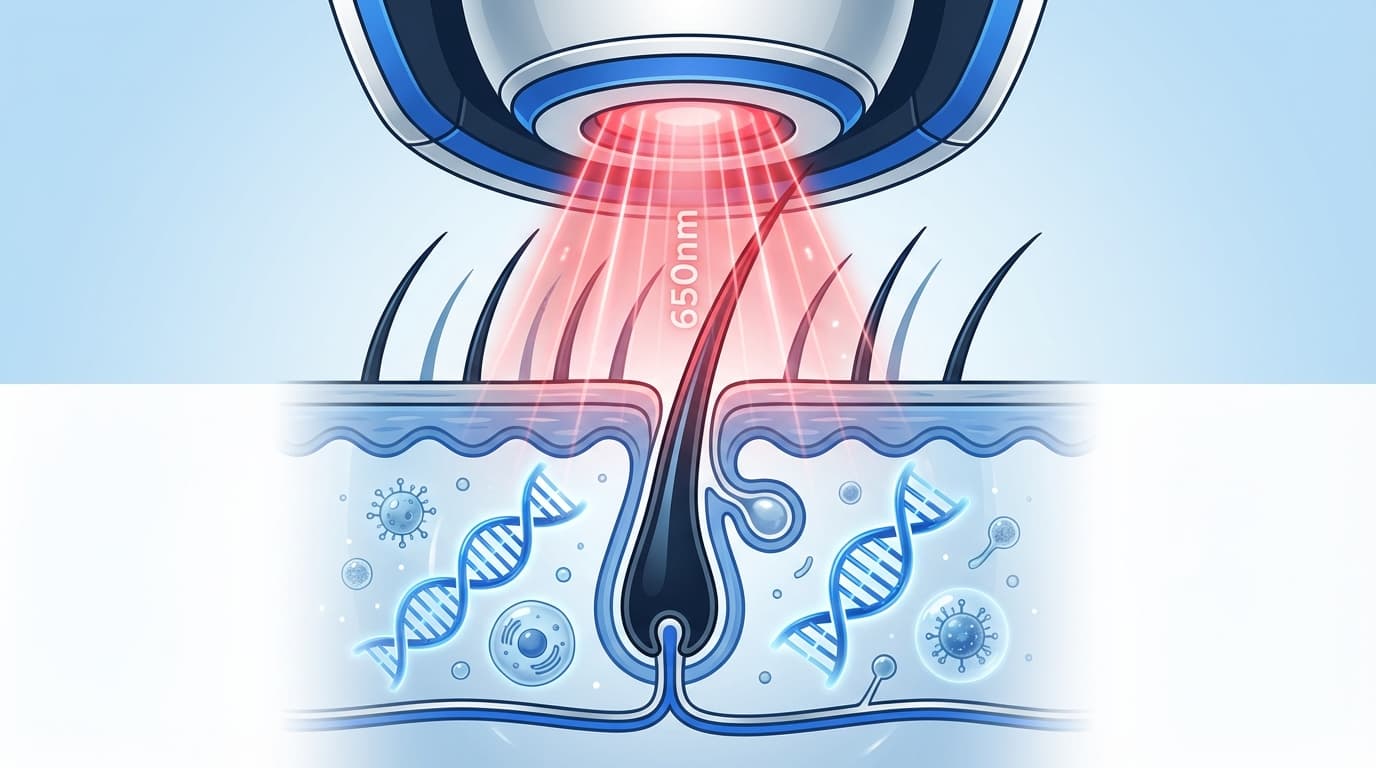
1. Wavelength: 650 to 670 nanometres
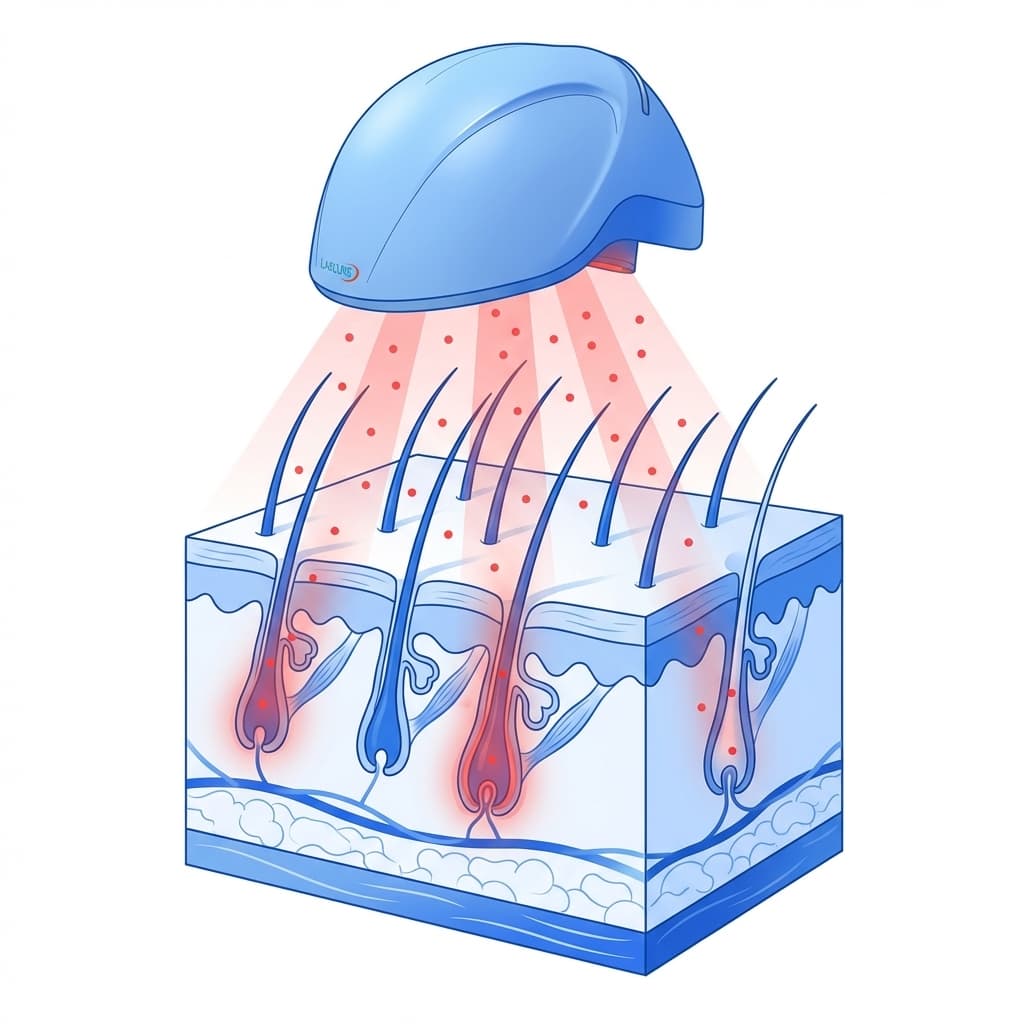
This is the key specification. The red light has to fall within this narrow band — short enough to penetrate the scalp, long enough to activate the mitochondria in hair cells. Below 650 nm you lose penetration depth; above 670 nm you lose the cellular stimulation effect.
Many cheap laser helmets sold on Amazon and similar marketplaces claim "red light therapy" but use simple red LEDs that fall outside this band, or with a much wider spectral spread. It looks red, but it doesn't work.
2. Power: 5 mW per laser diode
The power per diode determines whether enough energy reaches the scalp to stimulate hair follicles. Too low = no effect. Too high = heat and irritation. 5 mW is the proven sweet spot for LLLT — the same power class used in every published clinical trial.
3. Frequency and duration
For a laser helmet, the Haarstichting recommends 2 to 3 sessions per week, lasting 20 to 25 minutes each. For a laser comb, that's 4 sessions per week. Expected timeline:
- First visible results after 2-3 months
- Optimal results within 12 months
Why quality is so critical
The Haarstichting explicitly places a warning on their page, and it's worth quoting:
"Beware of cheap imitations that don't meet the specifications."
This isn't excessive caution. The laser helmet market is flooded with budget devices that make the right claims without the right hardware. Many devices under €200 have:
- LEDs instead of laser diodes (incoherent light, limited penetration)
- Too few diodes to guarantee full scalp coverage
- Unknown or incorrect wavelengths (often outside the 650-670 nm band)
- No FDA or CE certification to validate the specifications
The cynical result: people buy such a device, use it diligently for months, see no result, and conclude that "laser helmets don't work." When the science actually shows the opposite — if you're using the right device.
How Lascure scores against the Haarstichting criteria
This is the core of the article. Let's lay out the specifications of our three models against the criteria from the Haarstichting.
Criterion 1: Wavelength (650-670 nm)
- Lascure Ultra 552: 655 nm ±10 nm — ✓ middle of the band
- Lascure Pro 352: 650 nm ±10 nm — ✓ on the proven lower bound
- Lascure Essential 01: 650 nm ±5 nm — ✓ tightest spectral tolerance
All three models fall exactly within the optimal range cited by the Haarstichting. The Essential 01 even has a tighter tolerance (±5 nm) than the Ultra and Pro — in practice this means less energy lost to wavelengths outside the working spectrum.
Criterion 2: Power per diode (5 mW)
Our laser diodes and VCSEL units are calibrated to the clinically proven 5 mW per diode. This is the same specification used in the published trials (Jimenez 2014, Kim 2013, Lanzafame 2013) the Haarstichting refers to.
The difference lies in the number of diodes — and therefore the total energy reaching your scalp:
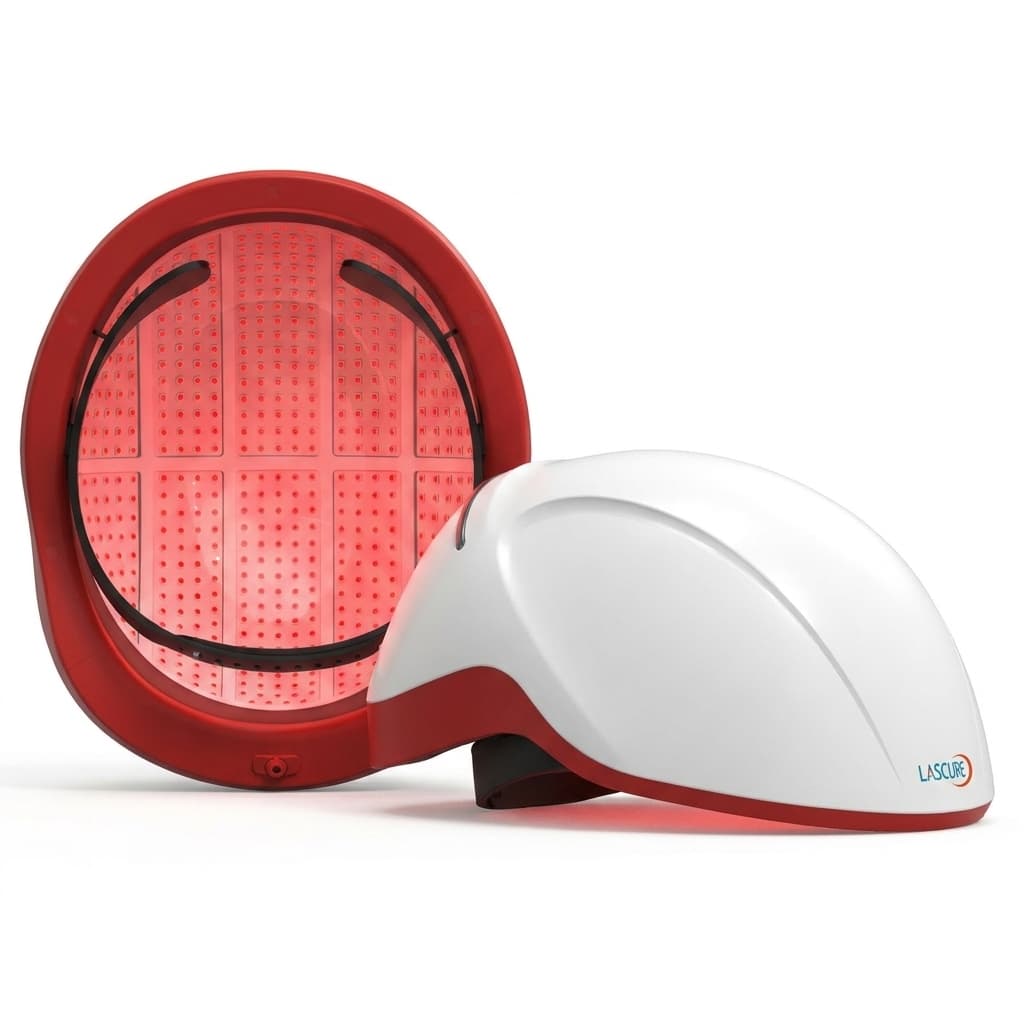
- Ultra 552: 552 light sources (352 VCSEL laser + 200 medical LED)
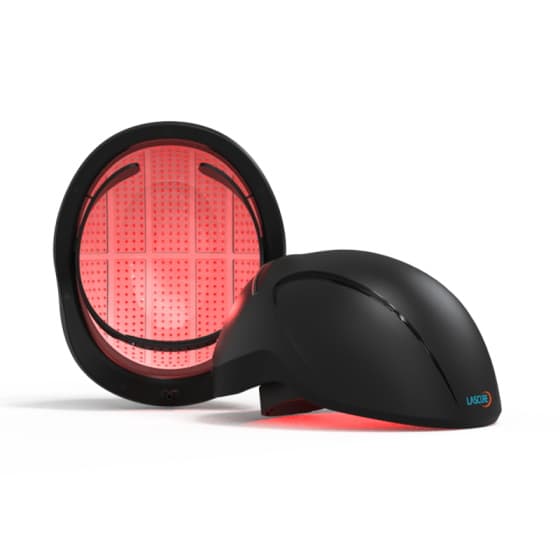
- Pro 352: 352 VCSEL lasers (100% laser, no LED supplement)
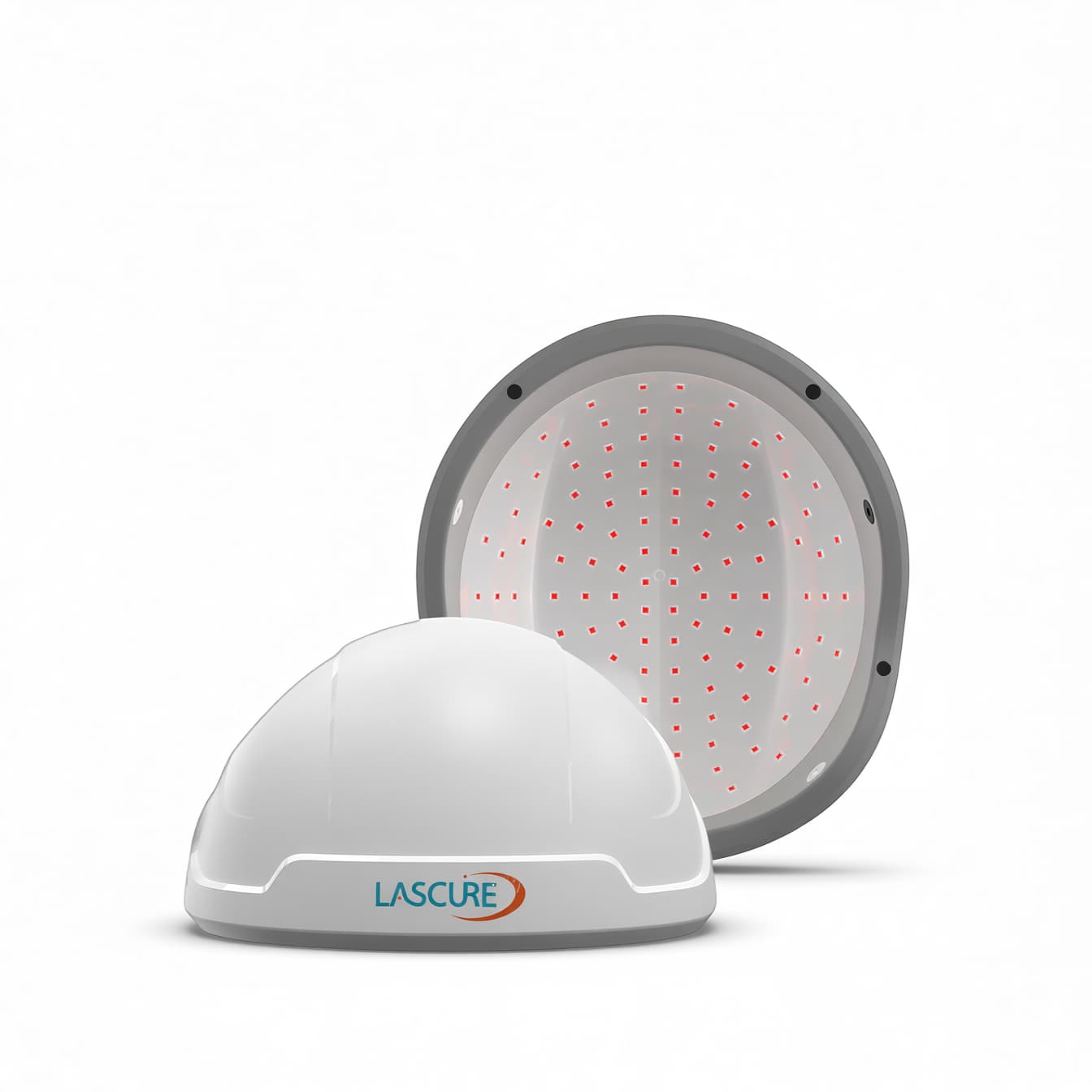
- Essential 01: 82 laser diodes
For context: the Haarstichting cites 5 mW per diode as the minimum. Many "entry-level laser helmets" on the market have 80-120 diodes. Our Ultra 552 has 552 — more than four times as many — meaning the total energy your scalp receives per session is significantly higher, with better coverage of both crown and hairline.
Criterion 3: Frequency and duration
The Lascure protocol is 3 sessions per week of 12-20 minutes — exactly aligned with the Haarstichting recommendation of 2-3 sessions per week, and on the shorter end of session duration thanks to higher diode density. More diodes = more energy per minute = shorter sessions for the same dose.
What Lascure does beyond the baseline criteria
The Haarstichting describes the minimum criteria for a laser helmet to work. There are a few areas where Lascure explicitly goes beyond that minimum.
VCSEL laser technology instead of traditional laser diodes
Most laser helmets on the market — including some well-known brands — use classic laser diodes or even LEDs. Our Ultra 552 and Pro 352 use VCSEL (Vertical-Cavity Surface-Emitting Laser): a newer laser technology developed for applications such as Apple Face ID and industrial precision sensors.
The difference for your scalp:
- More uniform light distribution. VCSEL units emit a circular, even beam. Classic laser diodes produce an oval, asymmetric pattern — meaning "hot" and "cold" spots across your scalp.
- More stable wavelength. VCSEL maintains a tighter spectral spread (±10 nm) than the average laser diode (±5 to 10 nm at higher temperatures).
- Longer lifespan. VCSEL arrays typically last 50,000+ hours, compared to 5,000-10,000 hours for classic laser diodes. Practically: your device doesn't lose its effectiveness within a few years.
FDA clearance and CE certification
One of the warnings from the Haarstichting is to avoid devices whose specifications haven't been independently verified. Our helmets are FDA-cleared (US Food and Drug Administration) and CE-certified (Conformité Européenne, EU). That means an independent body has confirmed that:
- The wavelength actually falls within the claimed band
- The power per diode is accurate
- The device is safe for home use
- The claims on the packaging match what the device actually does
An FDA number is no guarantee that a device works for your specific case — but it's a filter that screens out outright fakes.
Honestly: where the Haarstichting is cautious
An honest article should also include the caveats. The Haarstichting is explicitly cautious on several points, and I'm not going to gloss over them:
- LLLT is not a miracle cure. About 15% of users see little to no effect. Genetics, severity of hair loss, lifestyle — there are variables we can't predict.
- It works best in the early stages. Completely bald areas, where follicles have been dormant for years, cannot be revived by laser light. LLLT stimulates existing follicles — it doesn't create new ones.
- You have to keep using it. If you stop the treatment, hair loss gradually returns. Like medication or minoxidil, LLLT is a maintenance treatment.
- Best results when combined. The Haarstichting explicitly notes that LLLT combines well with other treatments — for example with hair transplantation as a supportive therapy, or with DHT blockers for a dual approach.
These are realistic expectations. We'd rather customers know what they're signing up for than be sold a dramatic promise.
What this means for you
If you're considering starting with LLLT, I'd recommend the following steps:
- Read the Haarstichting page yourself. Here. Form your own judgement — don't take my word for it.
- Ask yourself: am I still in the early stage? If your hair is clearly thinning but you're not yet bald, you're a good candidate. Receding hairlines or a slightly translucent crown are where LLLT works best.
- Check the device specifications. Wavelength between 650-670 nm? Sufficient diodes (at least ~80 for entry, 200+ for good coverage)? FDA and/or CE certified? If not — walk away.
- Be consistent. 3 sessions per week, no skipping. Results show after 12-24 weeks — not earlier.
- Consider combining with other treatments. Discuss with your doctor or dermatologist whether finasteride or dutasteride is something to add for a stronger combined approach.
Conclusion
The Haarstichting's endorsement of LLLT is meaningful validation for us as Lascure — not because we needed the confirmation (the published literature has existed for years), but because an independent Dutch authority now clearly explains what consumers should look for. That helps anyone trying to navigate the marketing jungle of hair loss products.
Our three helmets — Ultra 552, Pro 352, and Essential 01 — all meet the specific criteria the Haarstichting names: wavelength between 650-670 nm, calibrated power, and a usage protocol that fits within their recommendation. On top of that baseline, we add VCSEL technology, a high diode count, and international certifications.
Want to know which model fits your situation? Take the product quiz for personalised advice, or browse the full product overview. And if you're still on the fence: read the Haarstichting page first. We're confident that works in our favour.
Products mentioned in this article
More articles
Do laser helmets really work against hair loss? What science says
Discover what clinical research says about laser helmets for hair loss. An honest, science-backed analysis without overclaims.
Stop Hair Loss: 6 Proven Methods Honestly Compared
Your hair is thinning and you want to do something about it. But what actually works? We compare six treatments — from hair transplants to DHT blockers — on effectiveness, cost, and what you can realistically expect.
LLLT vs hair transplant: which is better for you?
A hair transplant delivers the most visible results, but costs thousands and requires surgery. A laser helmet works more gradually, but without cutting, without side effects, and at a fraction of the price. Which is the right choice?