Cheap vs Expensive Laser Cap: What the Price Difference Actually Buys You
Table of contents
A laser cap for €120 on Amazon or TikTok Shop. A laser helmet for €1,500 from a specialised retailer. Both claim to fight hair loss with red light. Both look suspiciously similar in the product photos. What is the difference exactly, and is it worth a tenfold price increase?
It is one of the most common questions in our inbox, and one of the most asked questions on Reddit, in hair loss Facebook groups, and in search engines. Understandable: a laser cap is a serious investment, and no one wants to feel they overpaid — or, worse, find out months later that the device in their drawer never had a chance of working.
At the same time, there is a warning hiding in this question. Because, unlike a hairdryer or a phone charger — where €30 will buy you something perfectly fine — laser caps have a fundamental difference between "cheap" and "expensive". And that difference is not in the brand, not in the box, and not in the design. It is in the things you cannot see in a product photo: the type of light source, the exact wavelength, the number of diodes, the calibrated dose, and whether the device has been tested by an independent regulator at all.
In this article I explain exactly where the price difference goes, what the science says works and what does not, and which specifications you need to verify before spending your money. Full disclosure: I work at Lascure. But if you read this and make an informed decision to buy a cheaper option that meets the right requirements, I will still consider you helped.
What people search for online about this topic
Before we dive into specs, a quick look at what consumers actually want to know. The most common questions around cheap versus expensive laser caps — based on search trends, forums, and our own customer questions — are:
- "Do those €100-200 laser caps actually work?"
- "What is the difference between LED and laser for hair growth?"
- "Why does a Capillus, Theradome or iRestore cost so much more than an AliExpress cap?"
- "How many diodes do I really need?"
- "Is FDA clearance important or just marketing?"
- "How long does one of these devices actually last?"
- "Has anyone used a budget laser cap from Amazon?"
The thread running through all of these: people do not want to be misled, neither by an expensive manufacturer nor by a cheap one. They want an honest answer to one question: what am I getting for my money?
The price spectrum: three segments
The laser cap market broadly splits into three price brackets, each with its own profile.
Budget: €80 – €250
Mostly found on Amazon, AliExpress and TikTok Shop. Many "red light caps" and LED helmets. Often generic OEM models sold under multiple brand names — the same physical cap appears across five different sellers at five different prices. No FDA clearance, no ISO 13485, and often only a basic CE mark for electrical safety (not medical). Specs are usually incomplete or vague ("red light therapy", with no concrete wavelength or power per diode).
Mid-tier: €350 – €900
Mostly branded products with basic laser diodes, correct wavelengths, and decent build quality. Some FDA-cleared. Treatment time of 25-30 minutes per session due to lower diode count. Examples: older iRestore models, Hairmax bands, and some Asian mid-tier brands. Here you typically do get the baseline specs the science requires, but without the extras in coverage and longevity.
Premium: €900 – €3,000+
High count of true laser diodes (200-550), often with VCSEL technology. FDA-cleared and CE-certified. Tight spectral control (±5 to ±10 nm). Short treatment sessions (12-20 min) thanks to high diode density. Examples: Capillus models, Theradome Pro, and the Lascure range.
What determines the price difference? Eight factors
1. Light source: LED, laser diode, or VCSEL
This is the biggest underlying difference — and the one cheap manufacturers prefer not to advertise. With LEDs you get incoherent light: a wide spread of wavelengths (often ±20 to ±50 nm) radiating in all directions. With laser diodes you get coherent light: a narrow band of wavelengths (±5 to ±10 nm) in a focused beam. With VCSEL (Vertical-Cavity Surface-Emitting Laser) you also get a circular, evenly distributed beam with even tighter spectral stability.
For your scalp, this matters. LLLT research (Jimenez et al. 2014, Kim et al. 2013, Lanzafame et al. 2013, Afifi 2017 meta-analysis) is almost entirely conducted with laser diodes — not LEDs. The published efficacy figures (~85% of users see hair loss stop) apply to laser-based devices. Studies on pure-LED devices are limited and produce mixed results. A cheap cap that claims "red light therapy" but uses LEDs under the hood cannot legitimately promise the same outcomes.
2. Number of diodes and scalp coverage
A budget laser cap typically has 80-120 diodes — distributed only across the top of the head. A premium helmet has 200-550, spread across crown, hairline, and sides. This may sound like a marketing number, but it directly affects:
- Coverage: the entire scalp versus just the crown. For receding hairlines and crown thinning combined, full coverage is critical.
- Energy density: the total joules per cm² your scalp receives per session.
- Session length: the more diodes, the more energy per minute, the shorter the session needs to be for the same dose.
3. Power and dose per diode
The Dutch Hair Foundation (Haarstichting) cites 5 mW per laser diode as the proven sweet spot — the same power level used in every published clinical trial. Many cheap devices do not even state this number, because it simply is not there. You can light a red bulb at 0.5 mW; it will look red, but it produces no clinical effect. Too little power = no biological response. Too much = heat and irritation. The 5 mW figure is not arbitrary; it is the value validated in the trials.
4. Wavelength accuracy and stability
The effective band lies between 650 and 670 nm. Cheap LEDs often fall outside this band, or have a spectral spread of ±20 to ±50 nm — meaning a substantial portion of the emitted light falls outside the working range. True laser diodes maintain ±5 to ±10 nm. VCSEL units are even more stable across temperature changes. The problem with budget devices is not just that the wavelength may be off at the moment of manufacture — it is also that it tends to drift over hundreds of operating hours.
5. Certification and independent validation
A laser cap that works is typically FDA-cleared (United States), CE-certified (Europe) and manufactured under ISO 13485 (medical-device quality management). That means an independent body has checked that the specified wavelength, power, and safety claims are accurate. A cheap laser cap without these certifications can claim whatever it wants on the box — there is no one checking.
6. Materials, battery, and build quality
A laser cap is a combination of optics, electronics, battery (in cordless models), and casing. Cheap devices use:
- Generic lithium batteries that lose substantial capacity within 200-300 cycles
- Plastic casing without thermal management — drastically shortening diode lifespan
- No cooling or feedback electronics — diodes degrade faster and you do not notice
Premium devices with VCSEL arrays typically last 50,000+ operating hours, compared with 5,000-10,000 hours for classic laser diodes in cheap housings. Practical difference: a budget laser cap can lose significant power within a year without you noticing — the light still looks red, but the dose reaching your scalp may have halved.
7. Clinical data per device
This is an underestimated factor. The published efficacy trials (Jimenez 2014 with 269 participants, Lanzafame 2013, Kim 2013) were run on specific devices with specific specifications. A manufacturer that builds to those specs can legitimately reference those studies. A cheap device that does not meet the specs cannot — and its efficacy becomes an open question. "Clinically proven red light" on the box of a budget cap usually means: studies on red light in general exist. Not: this specific device has been tested.
8. Warranty, support, and longevity
Cheap on Amazon: typically a 14-30 day return window, no meaningful warranty after that, no support, and a defect return-shipped to China that costs more than a new cap. Premium: 2-5 years of factory warranty, local customer service, replacement parts, and a manufacturer that still exists in five years. Factor that service into the price — it is a meaningful part of what you are buying.
What does €100-200 actually get you?
Honestly: not nothing. A budget laser cap in the €150 range usually has:
- 80-120 LEDs or weak laser diodes
- A red light source in the broad 600-700 nm range (without guaranteed precision)
- A battery for 1-2 hours of cordless use
- A useful lifespan of 6-12 months before noticeable degradation
What you do not get: evidence that it works on your scalp. The studies that "red light therapy for hair growth" rests on were not conducted with this class of device. Anecdotal positive reviews on Amazon often arise from natural fluctuations in hair growth cycles (hair always grows in phases, even without treatment), placebo effect, or a parallel treatment doing the actual work.
The problem is not that such a device is necessarily useless — it is that you cannot know. And by the time you discover after six months that you see no effect, you have already spent €150 and 90+ hours of sessions.
The hidden costs of going cheap
The real price gap is bigger than the sticker gap. Add it up:
- Lost time. A 20-30 minute session, three times a week, for six months. That is 70-90 hours invested in something with no way to know if it works.
- Replacements. A budget cap that degrades within 12 months means buying a new one — €150 times 3-4 replacements equals the price of a premium model, with the same uncertainty.
- Missed window. LLLT works best in the early stage of hair loss, when follicles are still active and miniaturised but not yet dead. Every month wasted on a device that fails to deliver the right dose is a month your follicles continue declining and the chance of recovery decreases.
- Mental impact. Someone who diligently uses a cheap laser cap for six months and sees no result often concludes "laser caps do not work for me" — when the device, not the principle, was the issue. That can cost you a viable treatment for years.
Buyer's checklist: ten things to verify
Whether you intend to spend €200 or €2,000 — verify these ten points on any laser cap before you pay:
- Lasers or LEDs? Prefer lasers (or VCSEL); LEDs only as a supplement, not as the main source.
- How many diodes? At least 80 for entry-level; 200+ for full coverage of crown and hairline.
- Exact wavelength? Between 650 and 670 nm. A specific number — not "red light" or "650-850 nm".
- Power per diode? 5 mW is the proven standard. If it is not stated, you do not know — and it is probably too low.
- Is it FDA-cleared and CE-certified? Ideally also ISO 13485 for medical-device quality management.
- Recommended treatment protocol? 2-3 times per week, 12-25 minutes, in line with the literature. "10 minutes daily" is not a clinical protocol.
- Device lifespan? At least 5,000 operating hours, ideally 50,000+ (VCSEL).
- Warranty and service? Minimum 2-year factory warranty. Local EU customer service is a plus.
- Which published studies does the manufacturer cite? Good manufacturers cite Jimenez, Kim, Lanzafame; poor ones reference only their own "internal studies" that were never published.
Where Lascure fits in
To make this concrete instead of abstract, here is how our three models map onto the same checklist:
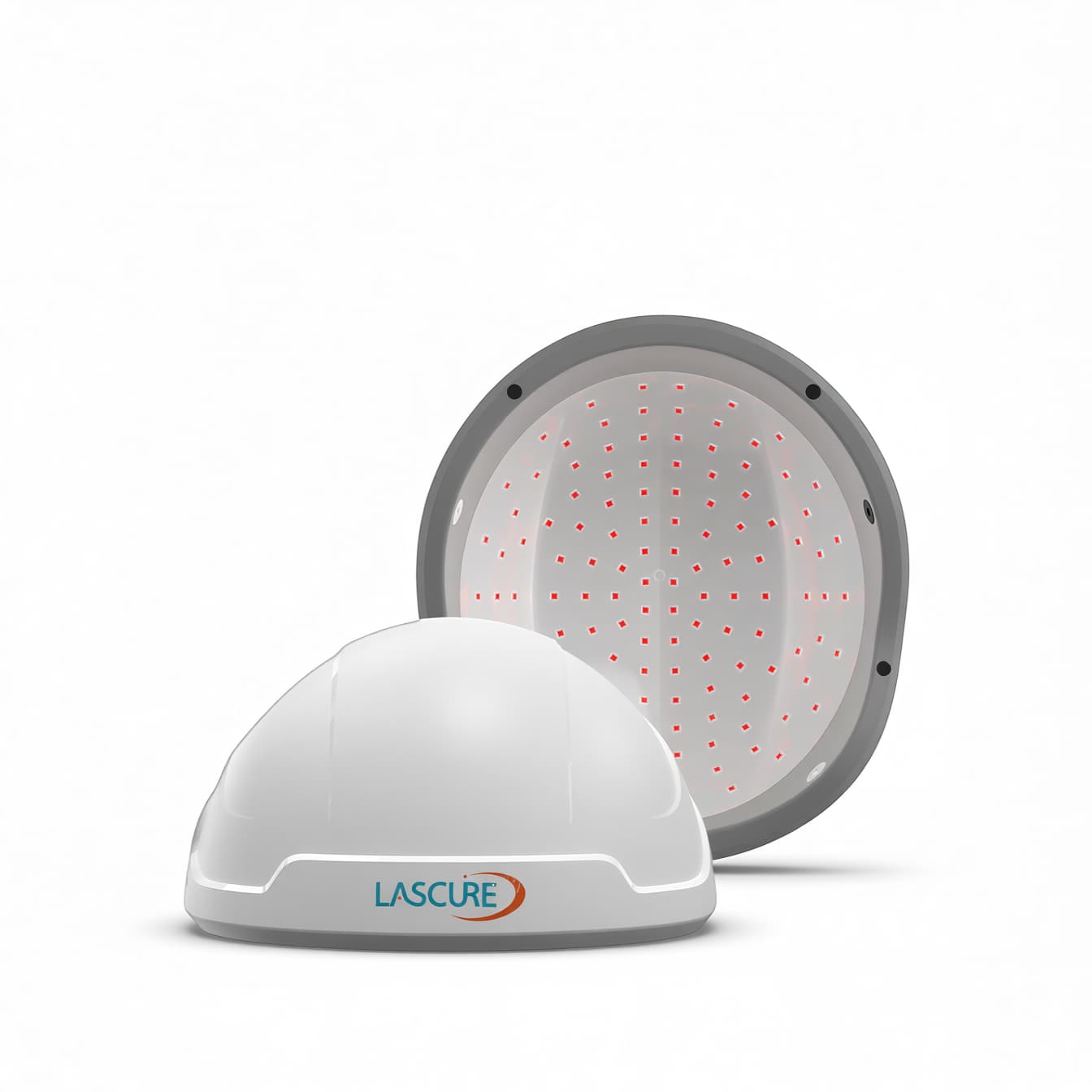
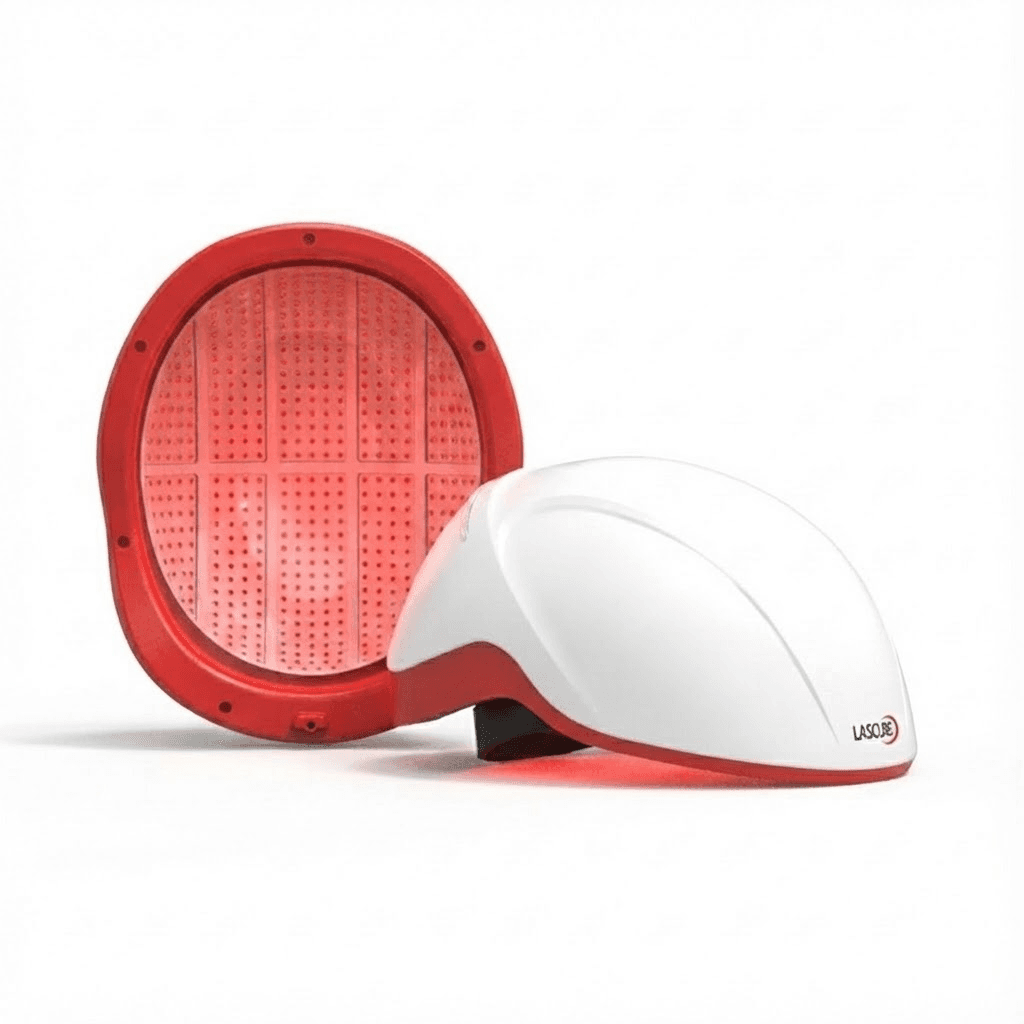
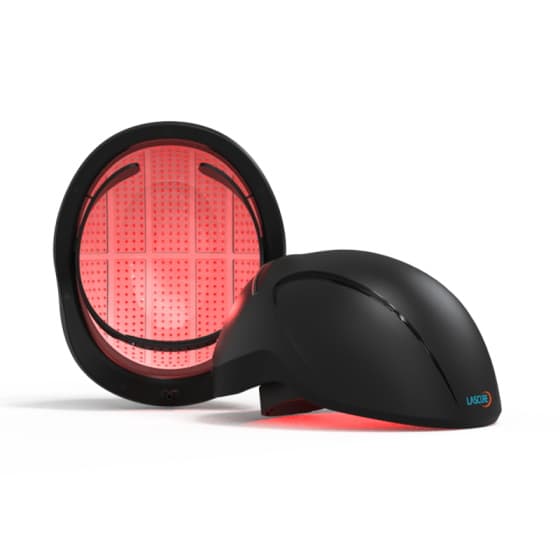
- Lascure Ultra 552: 552 light sources — 352 VCSEL laser plus 200 medical LED for additional coverage. 655 nm ±10 nm. 5 mW per diode. FDA-cleared, CE-certified, ISO 13485. 12-15 min sessions.
- Lascure Pro 352: 352 VCSEL lasers (100% laser, no LED supplement). 650 nm ±10 nm. 5 mW per diode. FDA, CE, ISO. 18-20 min sessions.
- Lascure Essential 01: 82 laser diodes. 650 nm ±5 nm (tighter spectral tolerance). 5 mW per diode. FDA, CE, ISO. 25 min sessions.
All three models meet the criteria for a working laser helmet set out by the Dutch Hair Foundation (see this article) and are built to the specs used in the published clinical trials. For anyone who wants those specs and that warranty — rather than gambling — the Essential 01 is our most affordable model with the same clinical-grade baseline as the most expensive. You pay less, but no specification is sacrificed; the difference is purely in coverage and treatment time.
When a cheaper option is acceptable
Not to be hypocritical — there are situations where a budget device is worth considering:
- If you simply want to test whether a laser cap suits you. Some people dislike the weight or fit. A cheap second-hand unit from a reputable brand can be useful to find out before investing in a premium model.
- If financially the choice is "cheap or nothing". A cheap device is not pointless — it is just uncertain. A few months of a budget device statistically beats no treatment at all, especially in early-stage hair loss.
- As an add-on to a primary treatment (such as finasteride or dutasteride). Here, the marginal contribution of the device is small enough that a budget version can be acceptable.
But if you intend to use it seriously as a primary treatment — to find out what 6-12 months of LLLT can really do — a €150 device from an unknown manufacturer is the wrong tool. For that role, you need hardware that meets the published specs and holds them across hundreds of operating hours.
Frequently asked questions
Why are Capillus, Theradome and Lascure so much more expensive than an AliExpress cap?
More and better lasers (laser diodes or VCSEL instead of LEDs), tighter wavelength control, medical certification with independent testing, longer factory warranty and local support. The difference is not in the shell — it is everything behind the shell.
Could I just buy several cheap caps for the price of one expensive one?
In theory, yes — but it does not solve the core problem: you still do not know if any of those devices meets the right specs. Three devices with unknown specs are no better than one with unknown specs. What does work: a single device that meets the established criteria and is built to last.
Do caps work as well as helmets?
The form-factor difference (cap vs helmet) matters less than the specs inside. A laser cap can work excellently if the hardware is correct — Capillus models, for example, are built as caps. What does matter is coverage: a thin cap with diodes only on the top covers neither sides nor back. For receding hairlines combined with crown thinning, full coverage is critical — choose a model that extends to the temples.
Are Amazon "best seller" caps reliable?
Amazon does not verify medical claims. Recommendations are algorithmic, based on sales volume and recent reviews. That tells you nothing about specifications or efficacy. Always verify the specs yourself (wavelength, power, certification) — not the Amazon rating.
Is a second-hand premium device a good buy?
If in good condition: yes. A 1-2 year old Capillus or Theradome typically retains 90%+ of its capacity. Ask for the FDA paperwork (so you know it really is the device it claims to be) and check whether the manufacturer still supports it — some brands do not transfer warranties.
Conclusion
The difference between a cheap and an expensive laser cap is not a marketing trick. It is the difference between a device that meets the specs the science was built on, and one that does not. Between a device tested by the FDA, CE and ISO, and one nobody has checked. Between an investment aligned with the published clinical data, and a gamble.
That does not mean only the most expensive device works. A mid-tier model with FDA clearance, the right wavelength, and the correct power can deliver real results. But under €250, with unknown specs and no certification — that becomes a coin flip.
The shortest summary: do not pay for a brand, pay for specs. Use the checklist above, and what you then choose — Lascure, Capillus, Theradome or another — matters less than knowing exactly what you have in your hands.
Want to know which Lascure model fits your situation? Take the product quiz or browse the full product overview.
Products mentioned in this article
More articles
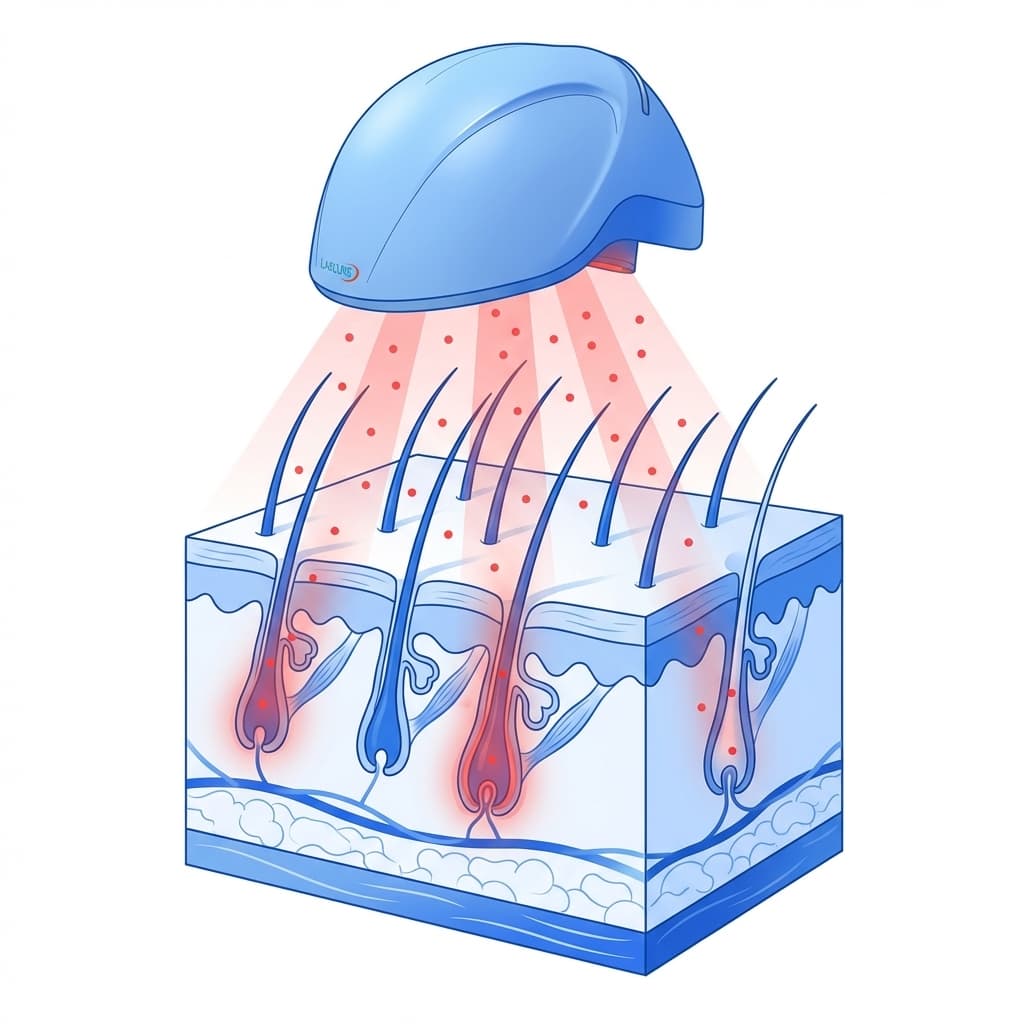
Do laser helmets really work against hair loss? What science says
Discover what clinical research says about laser helmets for hair loss. An honest, science-backed analysis without overclaims.
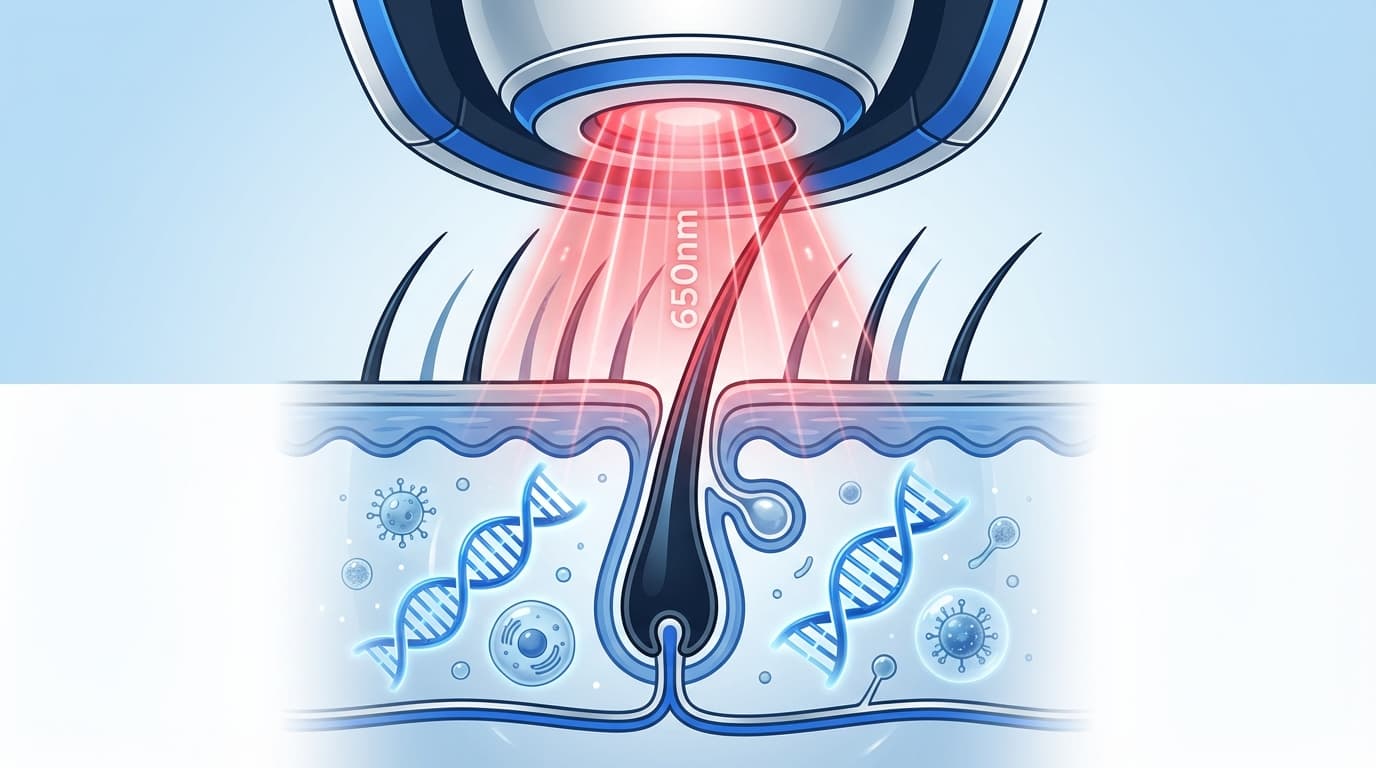
Stop Hair Loss: 6 Proven Methods Honestly Compared
Your hair is thinning and you want to do something about it. But what actually works? We compare six treatments — from hair transplants to DHT blockers — on effectiveness, cost, and what you can realistically expect.
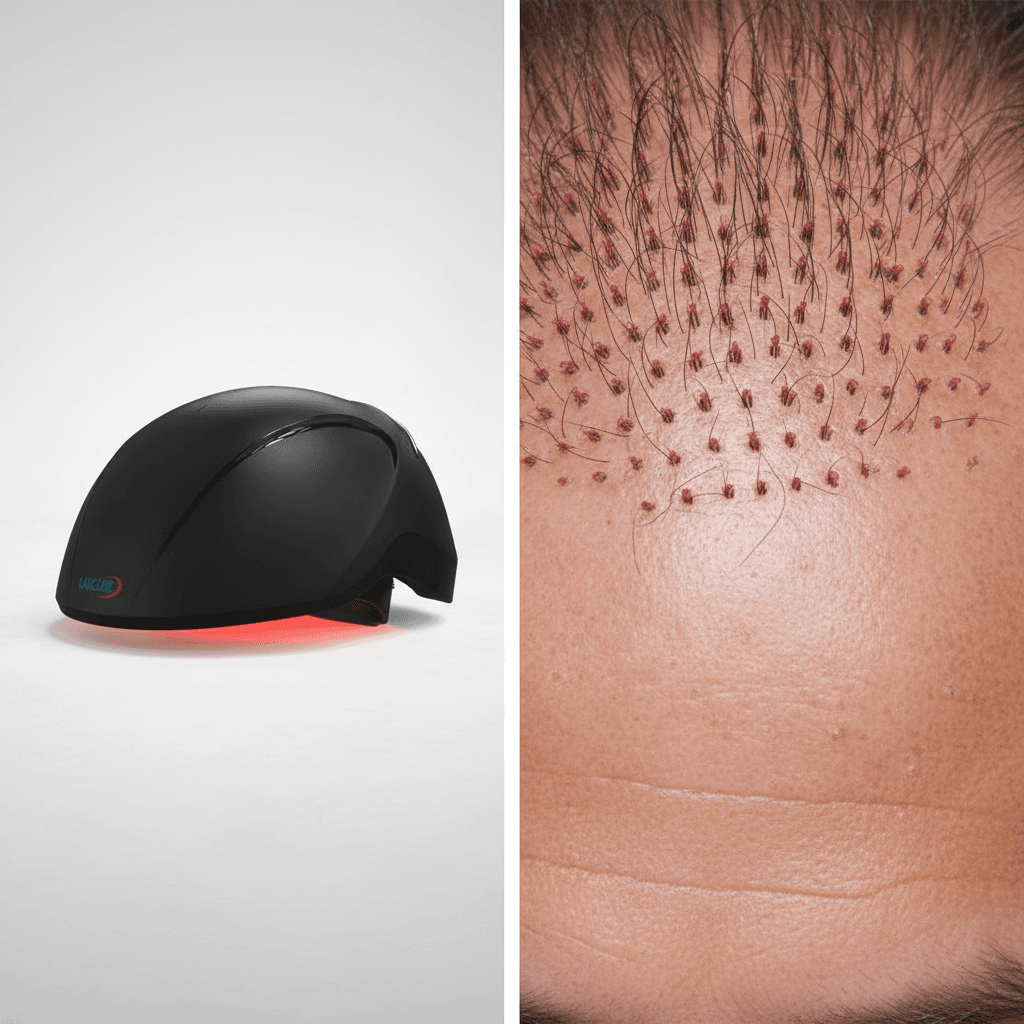
LLLT vs hair transplant: which is better for you?
A hair transplant delivers the most visible results, but costs thousands and requires surgery. A laser helmet works more gradually, but without cutting, without side effects, and at a fraction of the price. Which is the right choice?