Does Red Light Therapy for Hair Actually Work — or Is It a Scam?
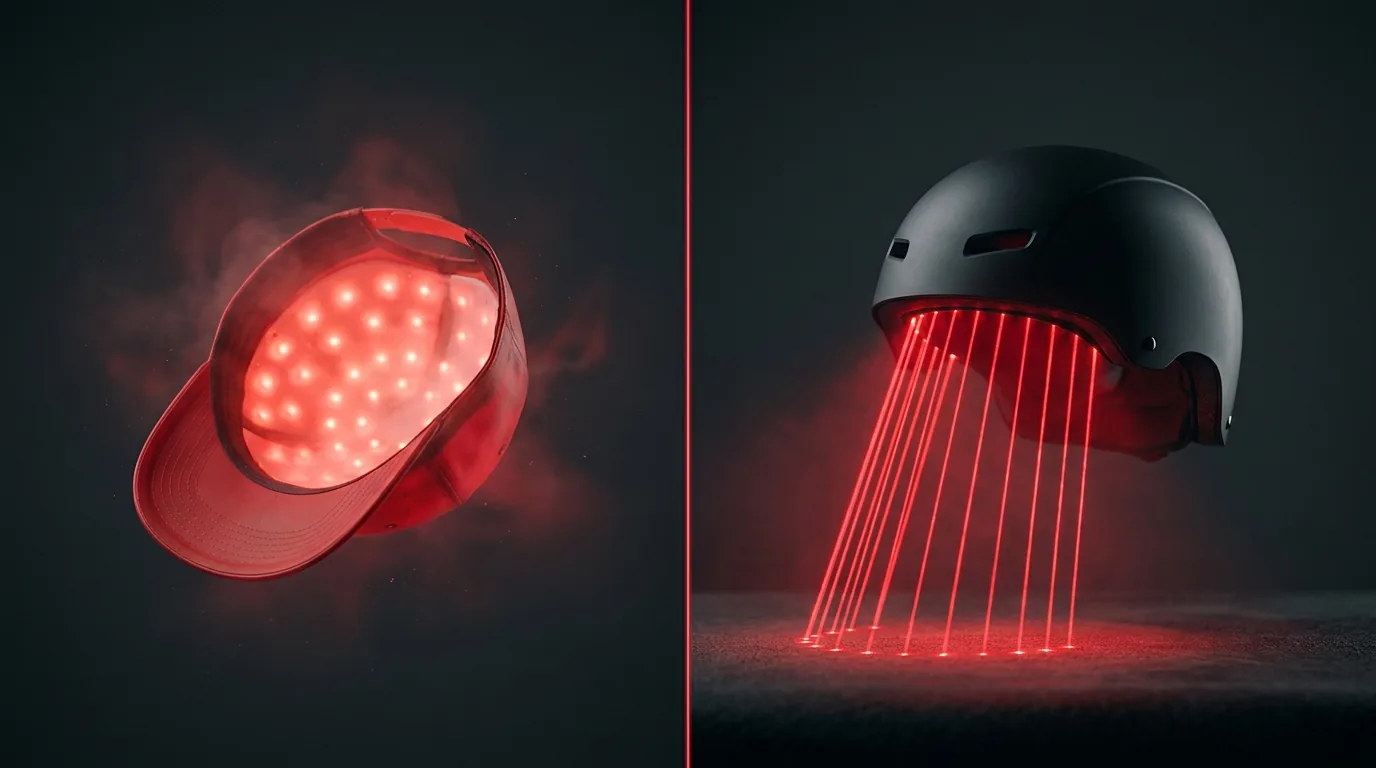
Table of contents
Short version — Red light therapy for hair (in the research literature: Low-Level Laser Therapy, LLLT) is not a scam: multiple randomised, double-blind, placebo-controlled trials and meta-analyses show it significantly increases hair density in hereditary hair loss, and the FDA has cleared devices for exactly this use. But the effect is modest, and it applies only to devices with real laser diodes, a wavelength of 650–670 nm, and the right dose (around 5 mW per diode). Many cheap "red light" caps miss all of that — which puts them closer to a scam than to a treatment.
"Does red light therapy for hair actually work, or is it a scam?" It is one of those questions that keeps coming up on Reddit, in hair-loss Facebook groups, and in our own inbox — and it is a fair question. The market is flooded with "red light caps", LED helmets, and laser caps ranging from €40 to €3,000, with near-identical product photos and near-identical promises. Anyone who searches finds a dermatologist who takes it seriously just as easily as a Redditor who swears he put €200 into a box that never grew back a single hair.
So let us work it out honestly — with the research in hand, and with the caveats most sellers would rather leave out. Full disclosure up front: I work at Lascure, we sell laser helmets. So I am not neutral. Precisely because of that, I try to be extra precise about what the research does and does not say, and honest about where in this market people actually get ripped off. If, after reading this, you make an informed choice for a different brand that meets the right requirements, I will still consider you helped.
What does the research say? Does red light actually work against hair loss?
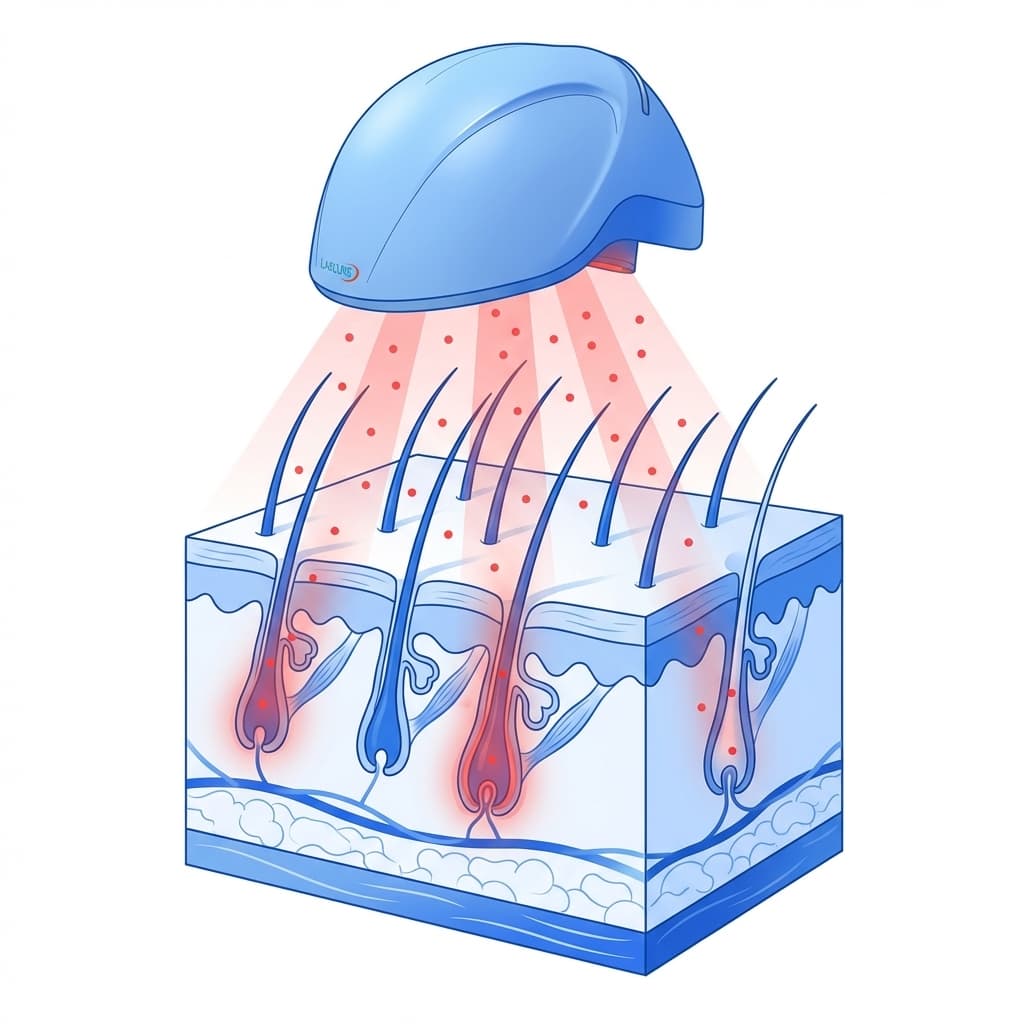
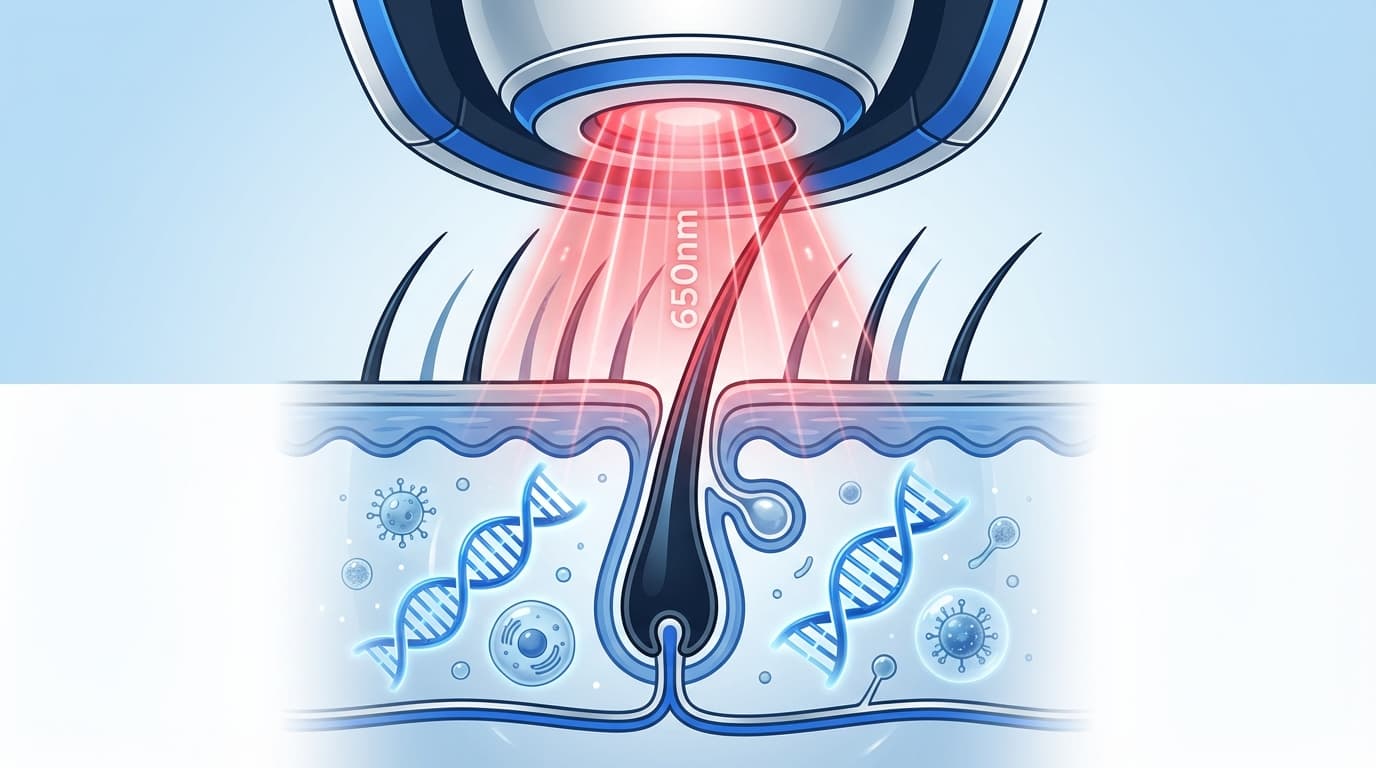
Start with the mechanism, because without a mechanism every claim is a guess. Red light in roughly the 630–670 nm range is absorbed by cytochrome c oxidase, an enzyme in the mitochondria of your cells — including the cells around the hair follicle. That absorption gives the cell's energy production (ATP) a nudge, dampens oxidative stress, and extends the growth phase (anagen) of the hair. This is called photobiomodulation. It is the same basic principle behind red light's use in physiotherapy and wound healing, here applied to follicles that are shrinking.
And the clinical evidence is there, and it is serious:
- Jimenez et al. (2014) — a randomised, double-blind, sham-controlled trial of 269 men and women found a significantly greater increase in hair density in the laser-helmet group than in the placebo group, with no serious side effects (published in American Journal of Clinical Dermatology).
- Kim et al. (2013) — a 24-week, randomised, double-blind, sham-device-controlled multicentre trial: significantly better hair growth and hair thickness with the real device than with the sham.
- Lanzafame et al. (2013) — comparable findings in men; hair count in the active group rose by roughly 35%.
- Afifi et al. (2017) — a systematic review and meta-analysis (in Lasers in Surgery and Medicine) pooling several RCTs and concluding that LLLT significantly increases hair density compared with placebo.
- Later systematic reviews and meta-analyses reach similar conclusions; LLLT is now listed in several treatment overviews for androgenetic alopecia, alongside minoxidil and finasteride.
That is a solid stack of evidence — stronger than for just about any hair supplement, and methodologically on a par with what exists for minoxidil. The Dutch Hair Foundation (Haarstichting) accordingly lists low-level laser as one of the treatments with supporting evidence (we wrote about that separately in this article).
But — and this belongs in the picture just as much — the honest caveats:
- The effect is modest. LLLT slows shedding and gives moderate thickening. It is not a hair transplant. Expect "more and thicker hair than without treatment", not "a full head where a bald scalp was".
- Some of the studies were manufacturer-funded. That does not make them worthless — they are still RCTs — but it is a reason not to take only the prettiest numbers at face value. Independent meta-analyses partly correct for this and remain positive; critical reviewers rightly point out that the studies differ widely in device, dose, and duration, which makes a single hard effect figure hard to pin down.
- It works best early. In early-to-moderate hair loss, where follicles are still alive but miniaturising. On genuinely bald areas, where the follicle is gone, there is nothing to stimulate.
- It is not a monotherapy miracle. The best results come from combinations — LLLT alongside minoxidil and/or finasteride, which tackle the hormonal cause (DHT).
- Compliance is everything. The trials used strict protocols, for months. Anyone who puts the device in a drawer after three weeks does not get the trial results — and has not really tested anything.
Bottom line for this section: it is not a scam technique. It is a proven, modestly effective treatment for the right type of hair loss — provided you use the right hardware and the right patience.
So why do so many people think it is a scam?
Because in practice they are often right — not about the technique, but about the product they bought or the way they used it. The most common reasons someone writes "it did absolutely nothing" on Reddit:
- They bought "just any red light" instead of the right red light. A red light panel from a webshop, a handheld "red light wand", or a cheap cap with LEDs claiming "600–850 nm". That is not the device used in the studies (more on that below). It looks red, so it feels as if it should do the same thing — but physics does not work that way.
- They used the right device the wrong way. Once a week instead of three times. Five minutes instead of twenty. Six weeks instead of six months. LLLT is slow: the first visible change usually does not appear until around week 12–16. Anyone who stops after a month has tested nothing.
- They started too late. Someone with advanced baldness who tries a laser helmet on the shiny crown sees nothing — rightly so, because there is no follicle left there to wake up. That is not a failure of the technique; it is the wrong patient for this treatment.
- The reverse mistake: fake positive reviews. Hair grows in cycles. Anyone just coming out of a resting phase (telogen) sees "suddenly" more hair — with or without a device. Add the placebo effect and the natural urge to justify an expensive purchase, and you get five-star reviews that prove nothing. That erodes trust over time: anyone who buys after such a review and sees nothing feels ripped off.
- Marketplaces verify nothing. Amazon, Bol, and TikTok Shop do not check medical claims. A "best seller" with 4.3 stars tells you something about sales volume and return policy — nothing about wavelength, power, or whether the device has ever been tested by anyone.
So the "scam" feeling is usually real — people just send it to the wrong address. Not "red light does not work", but "this product, or this way of using it, did not work".
What is a scam in this market — the red flags
Let us be concrete. These are the signals that mark a dubious or outright misleading product — and the more of them you see, the further away you should stay:
- LEDs sold as "laser therapy". The research (Jimenez, Kim, Lanzafame) was conducted almost entirely with laser diodes. A device that puts "low level laser therapy" on the box but uses ordinary LEDs under the hood borrows credibility it has not earned. Pure-LED devices have far less, and far more mixed, evidence.
- No exact wavelength. "Red light therapy" with no number, or an absurdly wide claim like "630–850 nm". The working band for hair is narrow (around 650–670 nm). A manufacturer that means it states the exact figure and the tolerance (e.g. 655 nm ±10 nm).
- No power per diode. If "mW per diode" appears nowhere, you do not know the dose — and it is probably too low. You can run a red bulb at 0.5 mW; it looks identical and does nothing biologically.
- Official-sounding marketing language that guarantees nothing. "FDA registered" sounds like a seal of approval, but it only means the company filed a registration — not that the FDA assessed the device. "FDA cleared" is an assessment. Watch, too, for vague terms like "medical grade" with no statement of which certification (FDA-cleared, CE, ISO 13485) the device actually holds.
- A generic OEM cap under five brand names. Try a reverse image search on the product photo. The same physical cap shows up on AliExpress, Amazon, and under five "brands" — at five different prices. A logo and a tenfold markup do not turn it into a medical device.
- "Clinically proven" — but which device? "Clinically proven red light" usually means: studies on red light in general exist. Not: this device with these specs has been tested. Good manufacturers cite Jimenez, Kim, and Lanzafame and build to those same specs; weak ones cite vague "internal studies" that were never published.
- Results promises with a deadline. "Visible results in 2 weeks!" No. The hair cycle does not physically allow it. Honest communication says week 12–16 or later, and speaks of "slowing shedding and moderate thickening", not a transformation.
- Little or no warranty and support. A 14-day return window, then nothing, and a defect return-shipped abroad that costs more than a new cap. A serious manufacturer offers at least two years of factory warranty and is reachable.
Cheap is expensive: the sum nobody does
The biggest thinking error on this topic is looking at the price tag instead of the cost. Say you buy a €150 laser cap from an unknown manufacturer, with no specified wavelength or power. What does that actually cost?
- The €150 itself — that part you see.
- 70 to 90 hours of your time. Three sessions a week of 20–30 minutes, for six months. Time you pour into something without knowing whether the hardware delivers the right dose.
- The lost window. LLLT works best early. Every month wasted on a device that fails to deliver the right dose is a month your follicles continue to miniaturise — and some will then be beyond recovery, with any treatment.
- The replacement cost. Many budget caps lose significant power within 6–12 months — the light still looks red, but the dose reaching your scalp has halved, and you do not notice. Buy a new one three or four times and you have spent the price of a decent device, with the same uncertainty intact.
- The biggest hidden cost: a written-off treatment. Someone who diligently uses a cheap cap for six months and sees nothing almost always concludes: "laser helmets do not work for me." When the device, not the principle, was the problem. That can cost you a viable treatment — and for anyone who then does nothing at all, it ultimately costs hair.
That is why "cheap" is often the most expensive option here. Not because only the most expensive device works — a mid-tier model with the right wavelength, the right power, and real certification can deliver real results — but because a device without those guarantees is a gamble whose outcome you only learn after six months, and that outcome cannot be undone. We broke this price difference down point by point in our deep-dive on cheap versus expensive laser helmets.
"Just any red light" is not the same as the right red light
This is the core of why one user sees results and another does not. Four things separate "something red" from "the device used in the studies":
1. Laser, not just any LED
An LED emits incoherent light: a wide spread of wavelengths (often ±20 to ±50 nm) radiating in all directions. A laser diode emits coherent light: a narrow band of wavelengths (±5 to ±10 nm) in one focused beam. A VCSEL (a type of laser) does that with an even more stable spectrum, even as the device warms up. The hair-loss research was largely done with laser diodes — the figures you see everywhere (a large share of users see shedding stop) come from laser studies, not LED studies. LEDs can play a supporting role, but as the main source they are far weaker.
2. The wavelength: a narrow window
Cytochrome c oxidase — the enzyme that "catches" the light — has an absorption peak around 660 nm. The effective band for hair lies roughly between 650 and 670 nm. An LED somewhere between 600 and 700 nm "roughly hits it", but a substantial part of the emitted light then falls outside the working range — energy that reaches your scalp without doing anything. And cheap light sources drift: the wavelength that was correct at the factory shifts away after hundreds of operating hours.
3. The dose: the Goldilocks zone
Photobiomodulation has a biphasic dose response — a quirk many cheap devices ignore. Too little energy: no biological response. Too much: you actually inhibit the cell (and get heat and irritation). The published studies and the Haarstichting cite around 5 mW per laser diode as the proven sweet spot. "More light is better" is therefore simply wrong here. A device that does not even state power per diode probably never made that trade-off.
4. Coverage and protocol
A thin cap with diodes only on the top does not cover your temples and the back of your head — yet a receding hairline is precisely there. And without a protocol resembling the studies (2–3x per week, 12–25 minutes, at least 16 weeks) you do not get their results. "10 minutes every day" or "put it on whenever you remember" is not a clinical protocol; it is a gamble with a timer.
In short: "red light" is a colour. "The right red light" is a coherent laser beam of roughly 650–670 nm, at roughly 5 mW per diode, across the whole scalp, on a fixed schedule, for months. The first you can buy for €40. The second is what the studies tested — and it is a fundamentally different product.
Who does it work for — and who does it not?
Honest expectation management saves a lot of "scam" feeling afterwards.
LLLT works best for:
- Early-to-moderate hereditary hair loss (androgenetic alopecia) — roughly Norwood-Hamilton II to V in men, Ludwig I to II in women.
- People with still-active, miniaturising follicles: thinning hair, not shiny bald.
- Those who stick with it — months, not weeks — and ideally combine it with a treatment that tackles the cause (finasteride/dutasteride against DHT) and/or minoxidil.
LLLT does not work, or barely, for:
- Completely bald areas — no follicle, nothing to stimulate.
- Hair loss with a different cause: thyroid problems, iron deficiency, telogen effluvium after stress or illness, alopecia areata. Those need a diagnosis first, not a helmet.
- People expecting a transformation. It is "slowing shedding plus moderate thickening", not "a transplant without surgery".
Not sure which category you are in? See your GP or a dermatologist first for a diagnosis and blood work. A laser helmet is worthwhile for the right type of hair loss — and a waste of money for the wrong type.
How not to get ripped off: the short checklist
Whether you intend to spend €200 or €2,000 — verify this before you pay:
- Laser or LED? Prefer laser diodes or VCSEL as the main source; LED at most as a supplement.
- Exact wavelength? A number between 650 and 670 nm, with a tolerance — not "red light" or "650–850 nm".
- Power per diode? Around 5 mW. If it is not stated, you do not know.
- Real certification? FDA-cleared, CE-certified, ideally ISO 13485 — meaning an independent body has checked that the claims hold up. Not just "FDA registered" or "medical grade" with no source.
- Which published studies does the manufacturer cite? Jimenez, Kim, Lanzafame, Afifi — not just its own "internal data".
- What protocol is recommended? 2–3x per week, 12–25 minutes, results from week 12–16. No "2 weeks" promises.
- Coverage, lifespan, warranty? Does it cover the temples and crown too? How many operating hours does it last? At least two years of factory warranty and reachable support?
The expanded version of this checklist — with an explanation per point — is in our article on cheap versus expensive laser helmets.
Where Lascure fits in
To keep this concrete rather than abstract — and yes, this is the part where we appear, so weigh it with that in mind. Our three models are built to exactly the specs from the research above:
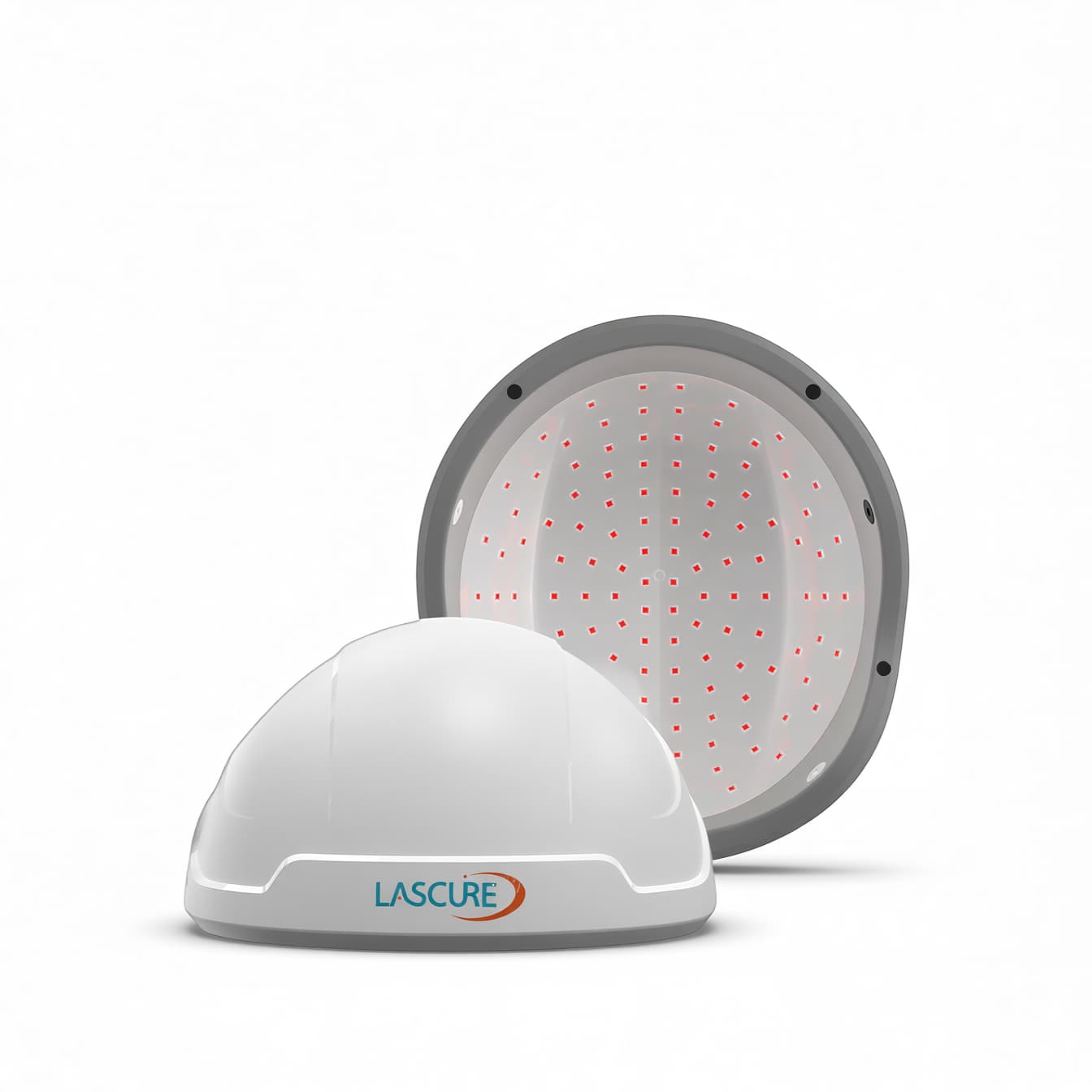
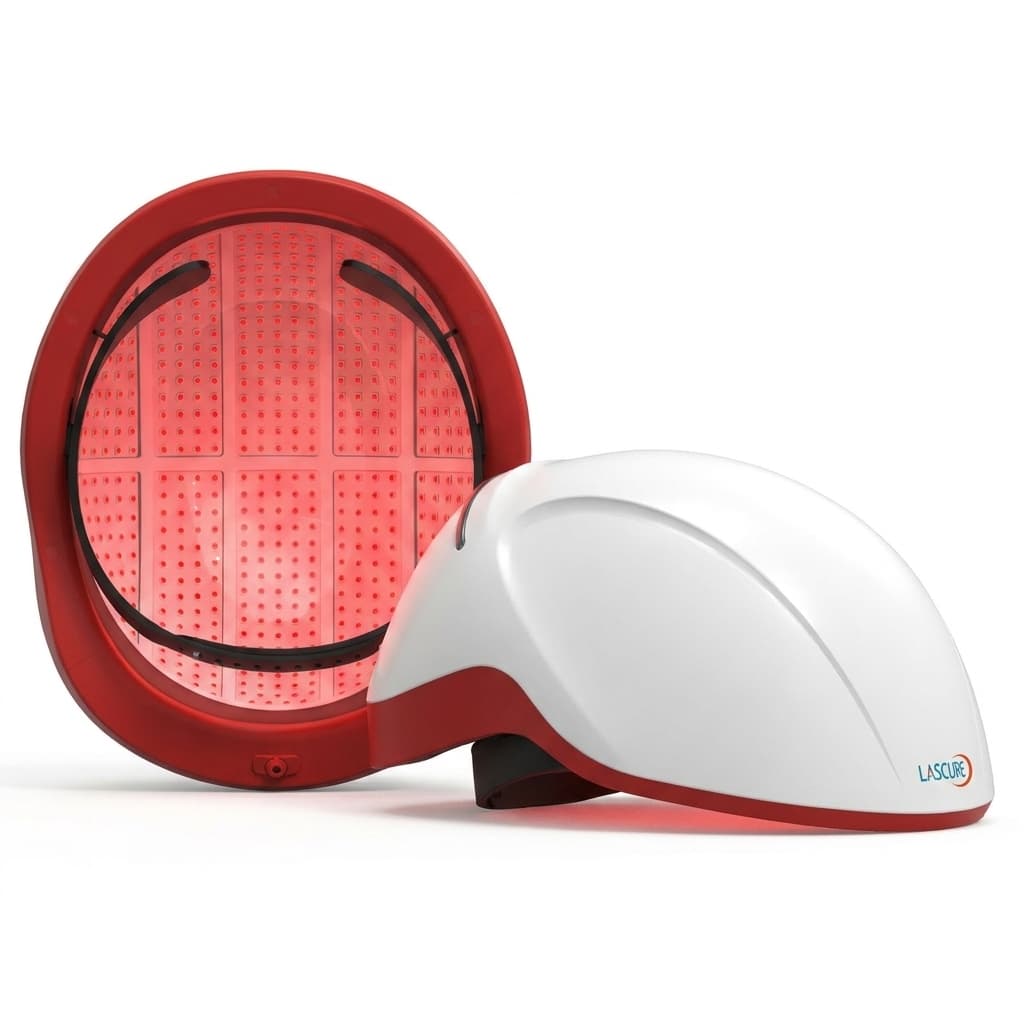
- Lascure Ultra 552: 552 light sources — 352 VCSEL lasers plus 200 medical LEDs for extra coverage. 655 nm ±10 nm. 5 mW per diode. FDA-cleared, CE-certified, ISO 13485. 12–15 minute sessions.
- Lascure Pro 352: 352 VCSEL lasers (100% laser, no LED supplement). 650 nm ±10 nm. 5 mW per diode. FDA-cleared, CE-certified, ISO 13485. 18–20 minute sessions.
- Lascure Essential 01: 82 laser diodes. 650 nm ±5 nm (tighter spectral tolerance). 5 mW per diode. FDA-cleared, CE-certified, ISO 13485. 25 minute sessions.
All three meet the criteria the Dutch Hair Foundation sets out for a laser helmet that actually works — we covered that separately in this article. For anyone who wants those specs and that warranty without gambling, the Essential 01 is our most affordable model with the same clinical-grade baseline as the most expensive: you pay less, but no specification is sacrificed — the difference is purely in coverage and session length. And if, after reading this, you make an informed choice for another brand that passes the checklist? Also fine. The point is that you know what you are holding — not a gamble in a box.
Frequently asked questions
Is red light therapy for hair scientifically proven?
For hereditary hair loss (androgenetic alopecia): yes, to a reasonable degree. Multiple randomised, double-blind, placebo-controlled trials (Jimenez 2014, Kim 2013, Lanzafame 2013) and meta-analyses (Afifi 2017 and later) show a significant increase in hair density. The effect is modest, not spectacular, and applies to laser-based devices with the right wavelength and dose — not automatically to every product with "red light" on the box.
Will a red light panel or a red lamp work for my hair?
Almost certainly not the way you hope. General red light panels and handheld "red light wands" use LEDs with broad spectra, are not designed for scalp coverage, and do not deliver the targeted dose per cm² used in the hair studies. They are meant for skin and muscles, not hair follicles. "It is red light, after all" is unfortunately not a valid argument — wavelength precision, coherence, and dose all matter.
How long before I see results?
Expect 12 to 16 weeks for the first visible change (less shedding, fine new hairs), and six months or more for a fair verdict. Anyone who stops sooner has not tested the treatment. Take before photos under consistent lighting; your memory is a poor yardstick for hair growth.
Is a laser helmet from Amazon, Bol, or TikTok Shop reliable?
Not based on the listing alone. Those platforms do not verify medical claims; "best seller" and stars say something about sales, not about wavelength, power, or certification. Some products there are fine, others are generic caps with unknown specs. Check the three things that matter yourself — wavelength, power per diode, and real certification (FDA-cleared/CE) — and do not let the rating lead you.
Does it work on complete baldness?
No. Where the follicle is gone, there is nothing to stimulate. LLLT is for follicles that are still alive but shrinking — so for early-to-moderate hair loss. For advanced baldness, a hair transplant is the appropriate route; LLLT can then support the graft afterwards.
Does red light therapy have side effects?
No serious side effects were reported in the studies. Occasionally mild, temporary redness or a warm feeling on the scalp. It is non-invasive: no needles, no medication. The main "side effect" is the time investment — and, with a poorly chosen device, disappointment.
What is the difference between LED and laser for hair growth?
A laser produces coherent light with a narrow wavelength band (±5–10 nm) in a focused beam; an LED produces incoherent light with a much wider spread (±20–50 nm) in all directions. The hair-loss research was predominantly done with laser diodes, so the published efficacy figures apply to laser. A pure-LED device that claims "laser therapy" leans on evidence that is not about itself.
Is red light therapy for hair a scam?
The technique is not — it has been confirmed in multiple RCTs and meta-analyses as a modest but real treatment for hereditary hair loss. But a fair share of what is sold under that label borders on it or is it: LED caps presenting themselves as laser, products with no specified wavelength or dose, "FDA registered" wordplay, and €30 caps with a brand logo and a tenfold price. The difference between "proven treatment" and "scam" here is not in the name — it is in the specs.
Conclusion: scam or not?
Red light therapy for hair is not a scam — the technique (LLLT, or photobiomodulation) has been confirmed in multiple randomised trials and meta-analyses as a modest but real treatment for hereditary hair loss, and there are FDA-cleared devices for it. But a large part of what is sold under that label is a scam, or close to it: LED caps presenting themselves as laser, products with no specified wavelength or dose, official-sounding marketing language that guarantees nothing, and €30 caps with a logo and a tenfold price.
So the real answer is "yes, but" — and the "but" is exactly where you need to look. Do not buy "red light", buy the right red light: real laser diodes, roughly 650–670 nm, roughly 5 mW per diode, full scalp coverage, a protocol like the studies', and certification checked by someone other than the manufacturer. Do that, and you have bought a proven treatment. Do not, and you have bought the story — in which case "scam" is indeed the right word, just not for the technique.
Want to know which Lascure model suits your situation? Take the product quiz or browse the full product overview.
Products mentioned in this article
More articles
Do laser helmets really work against hair loss? What science says
Discover what clinical research says about laser helmets for hair loss. An honest, science-backed analysis without overclaims.
Stop Hair Loss: 6 Proven Methods Honestly Compared
Your hair is thinning and you want to do something about it. But what actually works? We compare six treatments — from hair transplants to DHT blockers — on effectiveness, cost, and what you can realistically expect.
LLLT vs hair transplant: which is better for you?
A hair transplant delivers the most visible results, but costs thousands and requires surgery. A laser helmet works more gradually, but without cutting, without side effects, and at a fraction of the price. Which is the right choice?